
By: Money Navigator Research Team
Last Reviewed: 01/02/2026
 FACT CHECKED
Quick Summary
Tide’s in-person card acceptance pricing typically has three layers:
- A device cost (or a rental model where the device is included)
- A monthly plan fee in some tiers
- Per-transaction charges that vary by plan and card type
The warranty period is published separately and differs depending on when the device was purchased.
This article is educational and not financial advice.
What “Tide Card Reader” pricing actually includes
When people ask “How much is the Tide card reader?”, they often mean one of three different things:
The hardware cost (buying a reader outright, or paying £0 for the device under a rental-style option).
The ongoing plan costs (some tiers have a monthly fee, plus optional paid “boosts”).
The transaction costs (a fee applied per card payment, which can differ by plan and by card type).
Tide publishes its current card reader pricing and plan options on its product pages, which is the best single place to see the moving parts together. For the headline device prices and plan comparison, see the Tide POS Card Reader pricing and fees page.
Purchase costs: what the device itself costs (and why “from” matters)
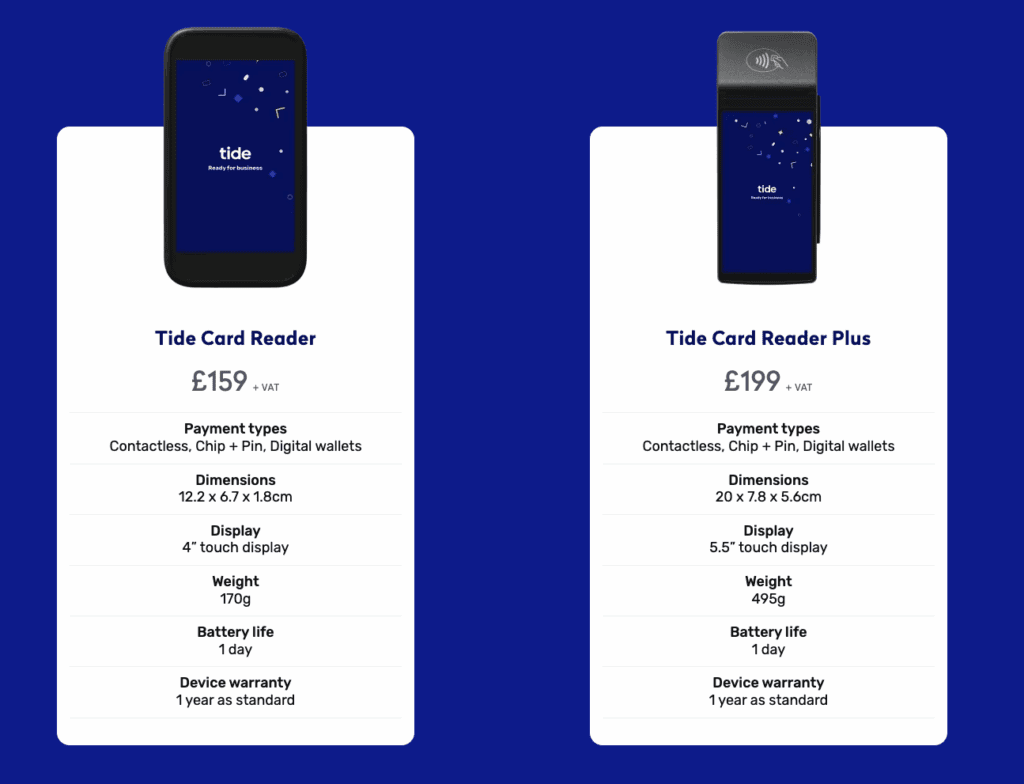
Tide markets two devices: Tide Card Reader and Tide Card Reader Plus. The published list prices shown for the devices are £159 + VAT (Card Reader) and £199 + VAT (Card Reader Plus) on Tide’s card reader page. Those figures are the clearest “buy the hardware” reference point. See Tide POS Card Reader pricing and fees.
Why Tide sometimes shows “from £99” for the device
On the same comparison table, Tide also shows device pricing as “from” a lower amount in some subscription configurations. “From” matters because it signals a starting price that depends on the specific option selected (for example, the device model or a plan bundle), rather than a single universal device price. The practical takeaway is that the total entry cost is plan-dependent, not just “the reader costs X”.
Renting vs buying: how the cost profile changes
Tide’s comparison table includes a rent-style option where the device cost is shown as £0 up-front, with a monthly plan fee and a stated minimum rental period.
From a cost-mechanics perspective:
Buying concentrates cost at the start (device price + VAT), then relies mainly on transaction fees and any plan add-ons.
Renting shifts the burden into recurring costs (monthly fee, minimum term, and optionally extra devices), which can matter for cashflow and for businesses that need multiple readers.
These are different commercial models, even if the on-screen experience of taking a payment looks similar.
The ongoing charges: what can apply after the device arrives
1) Monthly plan fees (if you choose a plan tier that has them)
Tide’s card reader pricing table includes options with a recurring monthly fee (+ VAT) and an option that is presented as £0 per month (pay-as-you-go), each with different transaction pricing.
The best reference for how Tide presents paid plan pricing more generally is Tide plans and pricing, while the card reader page is the specific place where in-person pricing is laid out alongside device costs. (Both are worth reading together when reconciling “account plan” costs and “payments” costs.)
2) Optional add-ons and “boosts”
Tide’s card reader pricing table includes optional paid add-ons such as a next-day settlement boost and a rent-another-device type of add-on within the rent-style model. The important point is that “ongoing charges” can be plan add-ons, not just transaction fees.
3) Per-transaction fees (the charge that scales with sales volume)
On Tide’s card reader page, transaction fees are shown as a percentage plus a fixed pence amount, and the table clarifies that the headline rates shown apply to a specific category (for example, domestic consumer debit cards), while other card types can price differently under Tide’s terms. See Tide POS Card Reader pricing and fees.
In other words, “my card reader costs” can rise simply because the business takes:
different card types (commercial cards, international cards), or
different payment methods (Tap to Pay vs reader), or
different plan tiers.
Summary Table
| Scenario | Outcome | Practical impact |
|---|---|---|
| Buy a Card Reader outright | Up-front device cost + VAT, then ongoing transaction fees | Higher first-month cost; simpler ongoing structure if no add-ons |
| Choose a rent-style option | £0 up-front device, monthly fee (+ VAT) and minimum term | Lower initial outlay; predictable recurring cost; may suit multi-device needs |
| Add optional boosts | Extra recurring charges | Costs can increase even if sales volume is stable |
| Accept different card types | Fee rate may differ from headline | Effective transaction costs can change without changing the sticker price |
| Issue a refund | Refund process and timing applies; tracking matters | Reconciliation and cashflow timing can be affected |
Warranty period and returns: what Tide publishes
Tide separates “commercial pricing” from “support and returns” information, which is helpful because warranty and replacement rules do not always match plan pricing.
Tide’s published warranty period is described in its support articles, including the point that the warranty period differs depending on when the device was purchased. See Tide Support: warranty period for the Tide Card Reader.
For delivery problems or defective units, Tide also sets out a process and time window for reporting certain issues (for example, incorrect items or damage during delivery). See Tide Support: returning a defective, damaged or incorrect card reader.
VAT and warranties: two separate concepts
VAT is a tax treatment, not a warranty feature. Tide’s pages often show device and plan costs “+ VAT”. For the baseline UK reference rate table, see VAT rates.
Warranties and guarantees sit alongside legal rights frameworks. For a general explainer of how warranties/guarantees fit into the wider “rights and remedies” picture, see Citizens Advice: claim using a warranty or guarantee and the statutory wording on satisfactory quality at Consumer Rights Act 2015, section 9.
(Those sources are general context; Tide’s own warranty wording and process remain the direct reference point for the Tide devices.)
How to track what you actually paid: device, fees and net receipts
A common point of confusion is that the “amount paid by the customer” is not always the same as the “amount that lands as available money” after fees and settlement mechanics.
Conceptually, card acceptance often involves a merchant account / acquiring layer that processes card payments, calculates fees, and then pays out net funds. If you want a neutral definition of merchant account structures used in payment processing platforms, see Adyen documentation on account structure.
(Tide’s in-person payment stack references a merchant-account style view inside the app, which is why fee visibility and payout timing often show up in a “sales/settlements” area rather than purely on the business current account statement.)
For deeper background on how “merchant account vs bank balance” concepts affect reconciliation, see our explainer: Merchant account vs EMI balance vs bank balance.
Summary Table
| Scenario-level | Process-level | Outcome-level |
|---|---|---|
| Device bought outright | VAT added to device invoice; transaction fees applied per payment | Higher initial invoice; ongoing costs scale with sales |
| Device included under rental model | Minimum term applies; extra devices can add recurring charges | Lower up-front cost; ongoing costs less sensitive to short-term sales dips |
| Optional settlement “boost” enabled | Payout schedule is accelerated for a recurring charge | Higher recurring cost; potentially faster availability |
| Refund needed | Refund initiated in sales/settlements workflow; processing time applies | Funds move back to customer; reconciliation needs matching references |
| Delivery damage / wrong device | Reported within stated time window; replacement process | Replacement may be issued after verification; downtime risk if single device |
Tide Business Bank Account
Tide offers business accounts and related payment tools under the Tide app experience. The card reader is one of the “get paid” options that can sit alongside the wider Tide business account proposition. For an overview of Tide’s business account features and positioning, see our hub page: Tide business bank account review.
Related in-person payments guides in this cluster include:
Frequently Asked Questions
Tide generally displays card reader device pricing and some plan/add-on pricing as “+ VAT”, meaning the advertised figure is before VAT is applied. This is common for business-to-business pricing displays where VAT treatment depends on the seller and the nature of the supply.
For the UK reference table of VAT rates (including the standard rate that applies to most goods and services), HMRC’s summary is the cleanest baseline: VAT rates. VAT is separate from card processing fees and separate from warranty terms.
Ongoing charges can exist, but they are not always “the card reader costs X per month”. Tide presents multiple ways to take in-person payments: a pay-as-you-go style option and subscription-style options (including a rental model).
In subscription models, the recurring charge is usually framed as a plan fee (plus optional add-ons), not as a “hardware fee” alone.
The practical distinction is between:
- Recurring access/feature pricing
- Transaction pricing
Both appear on the Tide POS Card Reader pricing and fees page and the wider plan context is shown on Tide plans and pricing.
Tide publishes different list prices for Card Reader vs Card Reader Plus, which means the entry cost for buying hardware can change depending on which device is chosen.
Tide’s card reader page shows the two device price points and also uses “from” language in the plan table, signalling that the effective device cost can depend on the plan configuration. See Tide POS Card Reader pricing and fees.
Beyond the sticker price, the more important cost difference is often operational: if one model supports a workflow better (for example, a more “POS-like” set-up), that can affect whether multiple devices or add-ons are needed.
Those secondary choices can change the recurring cost profile even if the device price gap is relatively small.
A £0 up-front device price typically indicates a rental-style or bundled commercial model rather than “free hardware with no strings”.
Tide’s comparison table pairs the £0 device line with a monthly fee and a stated minimum rental period for the rent-style option, which is a different pricing structure to buying a device outright.
In practice, “£0 device” usually means the cost is recovered via time (minimum term) and recurring charges rather than via the initial invoice. The relevant reference point is the comparison table on Tide POS Card Reader pricing and fees.
No – Tide’s published headline transaction fees are shown alongside clarifying wording that the displayed rate applies to a specific category (for example, domestic consumer debit cards), and other card types can have different pricing under the applicable terms. This is common in card payments because scheme fees, interchange and risk pricing can vary by card type and region.
That is why “the fee rate” can look stable in a marketing table but still vary in real-world mixes of payments. The correct starting point is the pricing table on Tide POS Card Reader pricing and fees.
Refunds are best treated as two things:
- The operational workflow inside the app (sales/settlements)
- The timeline for the customer’s card/bank to reflect the refund
Tide’s support flow for refunding a card reader payment describes the in-app path and notes that refunds are processed in up to a stated number of business days. See Tide Support: how to refund a payment to your customer.
Separately, many payment systems also have a reconciliation impact: the original sale, the fees, and the refund can appear as distinct entries across settlement views and statements.
That is why refunds can feel “slow” even when the refund action was taken immediately – processing and posting across multiple parties is part of the mechanics.
Device charges (buying a reader) are normally “invoice-style” costs: the purchase price, plus VAT, paid as a product purchase. Transaction charges are usually applied as a deduction from card takings or shown as fee lines associated with settlements, depending on how the merchant account layer presents reporting.
If “gross takings” and “net received” don’t align at first glance, it can be helpful to understand the conceptual separation between merchant processing and bank balances. Our explainer covers this accounting-chain idea at a higher level: Merchant account vs EMI balance vs bank balance.
Tide publishes a warranty period for the card reader in its support content, and it differs depending on the purchase date (including a change point referenced in Tide’s help text). The most direct source is Tide’s own support page: Tide Support: warranty period for the Tide Card Reader.
Tide states:
“The warranty period for manufacturing defects on card readers purchased before 6 August 2024, is 120 days.
For card readers purchased after this date, the warranty period is 1 year.”
Separately, consumer protection frameworks talk about “satisfactory quality” and other baseline standards, with statutory wording available in the Consumer Rights Act 2015, section 9. How those frameworks apply can vary by facts and purchaser status; Tide’s own warranty wording is still the operational reference for warranty claims on Tide devices.
Tide describes a process for defective, damaged, or incorrect devices, including a short reporting window for certain delivery issues and a returns/replacement workflow. This is addressed directly in Tide’s support article: Tide Support: returning a defective, damaged or incorrect card reader.
From a practical standpoint, this matters because in-person payments can have single-device dependency: if there is only one reader and it is out of service, sales processes may need an alternative method (for example, Tap to Pay or payment links) until the device is replaced. That operational risk is separate from the financial warranty terms.
Payout timing doesn’t usually change the nominal transaction fee, but it can change how “available money” is perceived day-to-day – especially when refunds, disputes, and delayed settlement windows are present. If a paid “faster settlement” option is enabled, that becomes an additional recurring cost, and the trade-off is between speed and price.
For the mechanics of authorised vs settled vs available (and why they are different concepts), see our dedicated guide: Tap to Pay on iPhone with Tide Payout Timing Explained. Even when the payment method is a card reader rather than Tap to Pay, the same conceptual “status ladder” is often what drives reconciliation confusion.
Card acceptance pricing is rarely “one number”. Tide’s card reader pricing makes that explicit by showing device costs, plan costs, and transaction costs side-by-side.
That presentation is helpful because it prevents a common misunderstanding: the cheapest device is not necessarily the lowest total cost, and the lowest transaction fee is not necessarily the cheapest option if the plan fee and add-ons are different.
The second structural point is that card payments are typically processed through a merchant/acquiring layer, which is why reporting often focuses on settlements, fee deductions, and payout timing rather than simply “money in, money out” on the current account statement. That separation is not unique to Tide; it is a standard feature of how card payments are processed and reconciled.
Related Content